Schools, offices, village halls, churches and heritage attractions are always adapting. As well as serving their original purpose, many now need to work harder and bring in extra income, opening their doors for events, hires, community groups and private functions. Spaces are being repurposed and buildings extended to create flexible, multipurpose venues.
For those spaces to work for everyone, they need to be accessible. In older buildings that weren’t purpose built, changes in floor level and flights of stairs can make it difficult for every visitor to reach every part of the site. There are several ways to improve access, from step lifts to vertical lifts. But where there’s already a staircase, one of the most practical solutions is to make the stairs wheelchair accessible with a platform stair lift, with no lift shaft and minimal or no building work required.
Inclusive environments are a priority for every organisation we work with, which is why so many schools, churches, village halls and heritage attractions turn to us for the best way to make their stairs wheelchair accessible.
Is a platform stair lift right for your building?
Every project we take on begins with a conversation about how a building is used today, and how it will be used in future. A school might be planning for pupils and staff with a range of mobility needs. A venue might want its upstairs function room to welcome every guest at a wedding or celebration. A historic house might be opening new rooms to visitors for the first time.
Whatever the setting, the goal is the same: a building that everyone can enjoy with dignity and independence. That means a wheelchair user taking the main route through the building like everyone else, reaching the toilets without going outside in the rain, and staying with friends or classmates rather than being sent the long way round past the bins and back doors.
A platform stair lift is often the most practical choice when:
- There’s already a staircase or flight of steps on the route people need to use
- There isn’t the space or budget for a vertical platform lift
- Major building work isn’t an option, perhaps because the building is listed or the space needs to stay in use
- The staircase still needs to work for everyone else, as the platform folds away against the wall when not in use
- The lift will be used as needed rather than constantly, for example by a pupil between lessons or guests arriving for an event
If that sounds like your building, a platform stair lift could be the simplest way to improve disabled access in an existing building, both inside and outside.
How does a platform stair lift work?
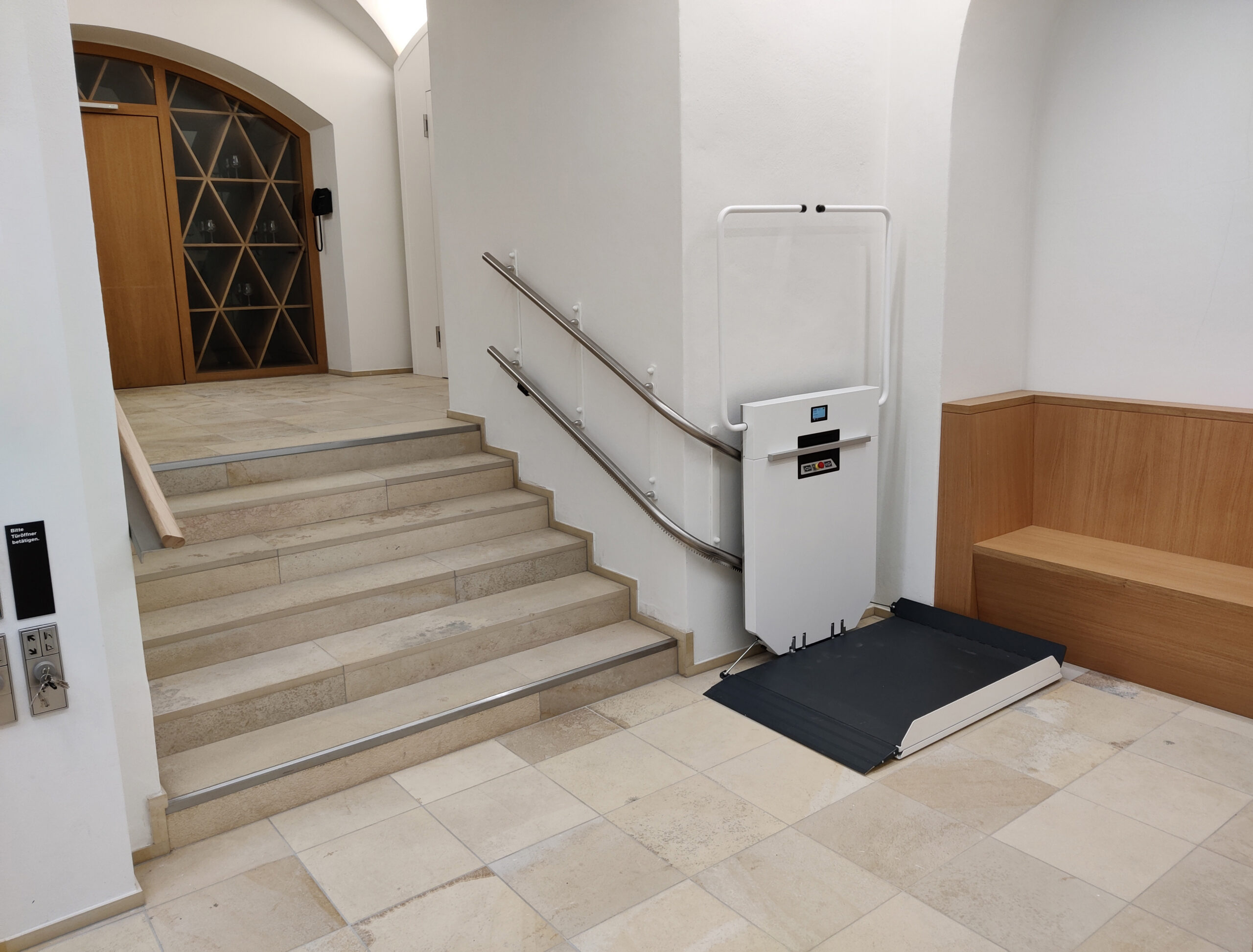
Most people picture a stairlift as a seat that runs up the side of the stairs in someone’s home. A platform stair lift is different. Sometimes called a wheelchair stair lift or a wheelchair lift for stairs, it has a flat platform instead of a seat, large enough for a wheelchair, so the user can stay in their chair for the whole journey rather than having to transfer.
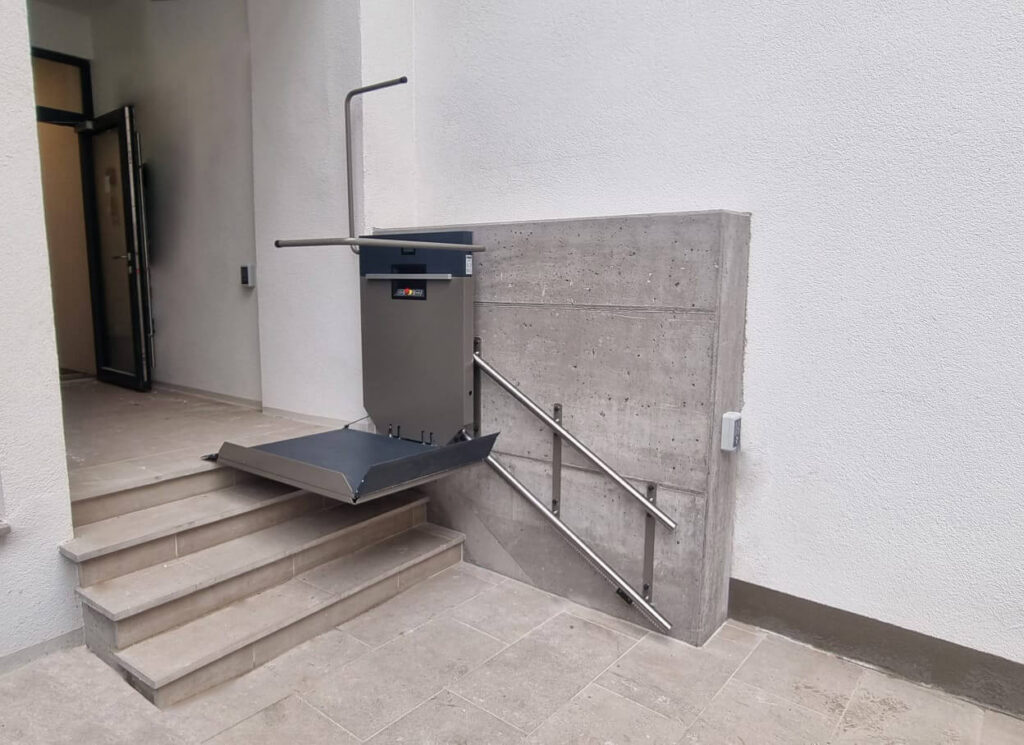
The platform runs on slim rails fixed to the wall or the stairs, and follows the line of the staircase, navigating tight bends, landings and changes in gradient. When it isn’t needed, it folds up against the wall by the simple press of a button, taking up very little room. The staircase stays fully usable for everyone else, which is important in busy buildings or where the stairs form part of an escape route.
Platform stair lifts are also very economical to run. They operate on rechargeable batteries that are kept topped up from a standard power supply, so they cost very little in electricity and keep working during a power cut.
We install platform stair lifts in both commercial and residential settings, indoors and outdoors, including marine-grade models for coastal sites and swimming pools.
How is a platform stair lift installed?
Because a platform stair lift uses the stairs that are already there, there’s no need to build a lift shaft or make major structural changes. That’s what makes it such a practical way to provide wheelchair access to stairs in older and listed buildings, or anywhere space and budgets are tight.
The process starts with a site survey, where the staircase, walls, landings and power supply are assessed and measured. The lift is then made to fit that staircase, which usually takes six to eight weeks. Installation itself is quick, typically one to two days, so a building can stay open with very little disruption. For schools, that means a lift can be planned in spring and fitted over the summer holidays, ready for the new term.
How is a platform stair lift operated?
Using a platform stair lift is straightforward. A wheelchair user calls the lift with a button at the top or bottom of the stairs, and the platform unfolds ready to use. Once they’ve rolled on, safety arms lower into place and a small ramp lifts to stop the wheelchair rolling off. The user then holds down a button to travel, and the lift stops automatically at the other end.
Controls are designed to be easy for everyone, with clear displays and, on some models, voice prompts. Wireless switches at each landing and handheld remotes mean the lift can be used independently or operated by staff where support is needed. Safety features come as standard, including obstruction sensors that stop the lift if anything is in its path, non-slip surfaces and emergency stop buttons.
What we love most about GTLE is its digital display, which shows operating status, system readiness and diagnostic information in real time. If there’s ever an issue, our engineers can troubleshoot it quickly using the error codes, and nine times out of ten it’s simply because someone has pressed the stop button. The digital display also has voice output, giving users clear spoken and audible cues.
Why platform stair lifts are a popular choice for schools, community venues and historic buildings.
The GTLE platform stair lift is undoubtedly our best-selling product for schools and colleges. Wheelchair access in schools is a big part of our work, and most of our recent projects have been with schools wanting a disability access solution to overcome steps in corridors leading to classrooms or halls. Many schedule the installation for the holidays so lessons aren’t disrupted.
At Laurel Lane Primary School in Middlesex, five internal steps separated the main entrance from the lower floor classrooms. To welcome pupils with mobility needs, the school chose a GTLE, which we installed during the half-term holiday with no structural alterations. At Filey Academy, we fitted a GTLE alongside six steps in the main corridor in a single day, giving wheelchair users access across the school without any building work. Saltash Community School in Cornwall had relied on a platform stair lift for many years, and when it was time for a replacement, the school wanted the work done over half-term. Our wall-mounted GTLE was installed within a day, keeping wheelchair access to the RE department in place.
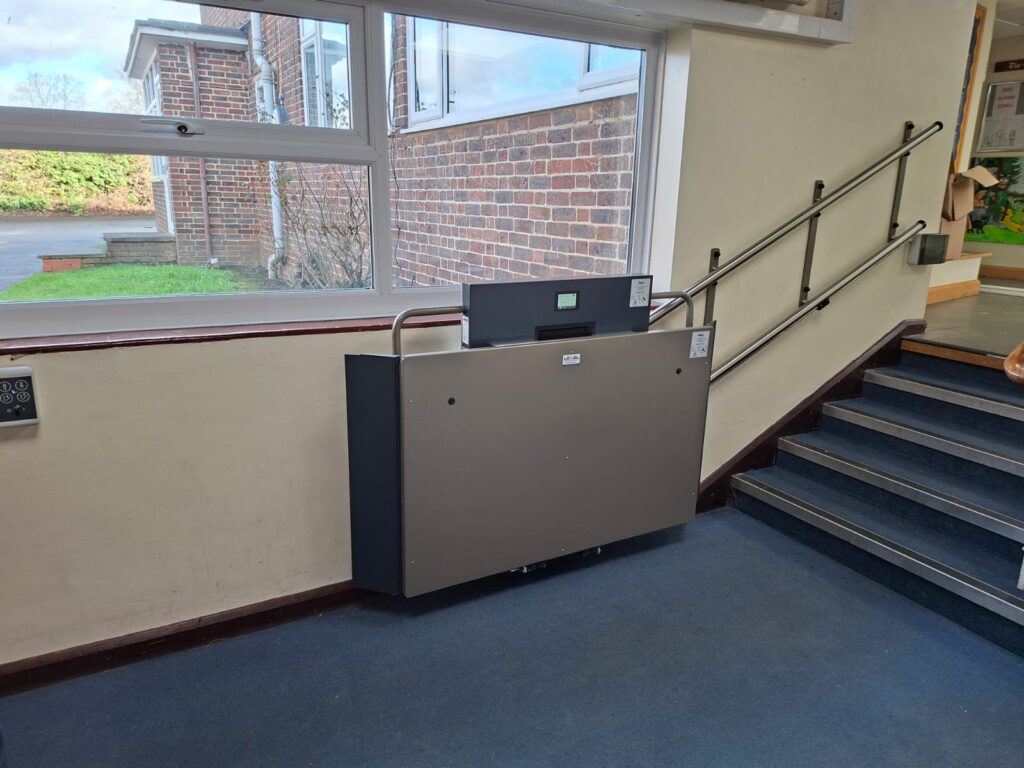
Community buildings are making the most of their space too. The Rushden Historical Transport Society Goods Shed is a restored railway building that now serves as a community hub and events venue. A GTLE gives visitors access to the upper level and toilets, with no structural alterations to the historic building.
We are also frequently contacted by historic houses needing a platform stair lift for external entrance steps, or inside the property to open up new areas to visitors. One of the big advantages of a platform stair lift in a historic or listed building is that it is reversible and doesn’t affect the historic fabric.
At Ushaw Historic House, Chapels and Gardens, four steps stood between the main house and a new Library Gallery. A GTLE now gives visitors with limited mobility direct access to the gallery, without impacting the building’s historic fabric. At Harewood House in Yorkshire, we installed a GTLE on the external steps leading to the State Hall entrance, with a bespoke rail engineered to follow six steps of varying height and depth.
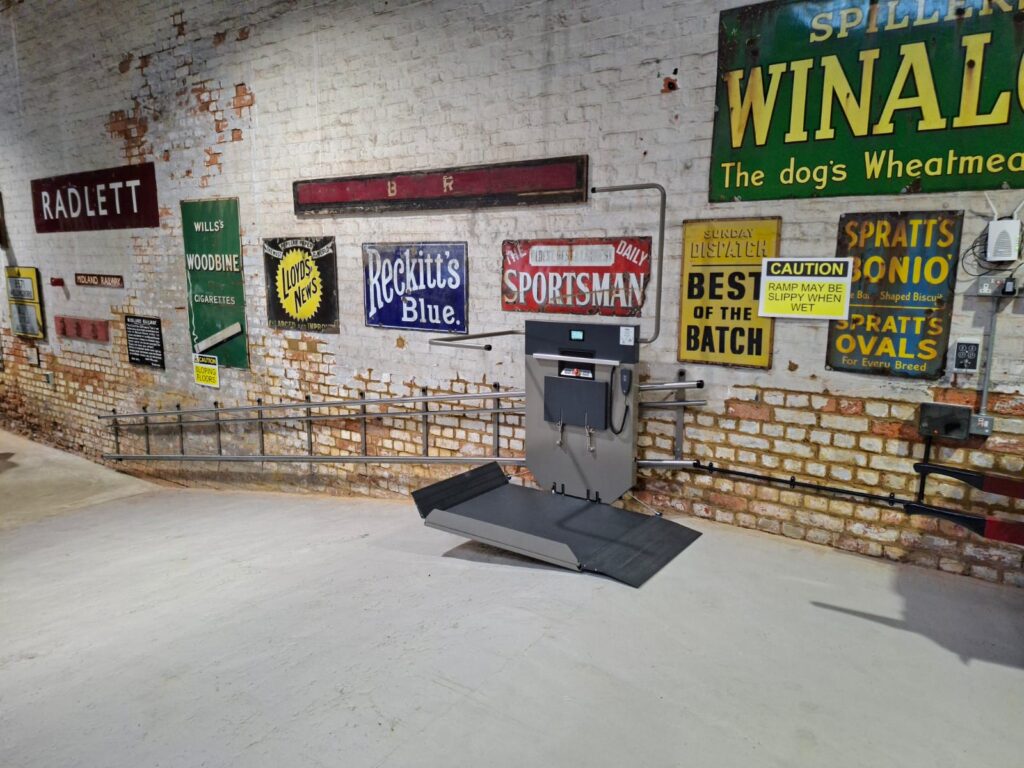
Churches benefit too. At St Oswald’s Church in Rugby, a GTLE finished in a bespoke colour blends with the oak-framed interior and gives fully independent access up the chancel steps.
One last project which proves the GTLE can navigate almost any staircase is The Loft, a community space run by the charity Reestablish on the upper floor of a Leeds warehouse. The only way up was three curved flights of stairs. A GTLE now carries wheelchair users all the way up, so the charity can offer a fully inclusive space.
Make your stairs wheelchair accessible
Whether you’re planning ahead for a new school year, opening up a function room for events or welcoming visitors to a historic building, our team can help you find the right solution.
Frequently asked questions
No. When it isn’t in use, the GTLE platform stair lift folds up flat against the wall, leaving the stairs clear for everyone else. Our site survey shows exactly how much space the lift takes up, both folded and in use.
Yes. A platform stair lift runs on rails fixed to the wall or the stairs, carrying a wheelchair user up and down the existing staircase. There’s no need for a lift shaft or major structural work, and installation usually takes just one or two days.
Yes. Platform stair lifts are often the preferred choice for listed and historic buildings, as no structural alterations are needed and the lift can be removed in future without lasting impact.
Yes. The GTLE is designed for both straight and curved staircases, and can follow tight bends, landings and changes in gradient. At The Loft in Leeds, it climbs three curved flights of stairs.
Yes. Users call the lift with a button at each landing, and simple controls, a clear display and voice cues make it easy to use. Safety arms and ramps work automatically. It can also be operated by staff with a handheld remote where support is needed.
Each lift is made to measure after a site survey, which usually takes six to eight weeks. Installation is typically completed in one to two days, so it fits easily into half-term or the summer holidays. Ordering in good time means the lift is ready for the start of term.
Yes. Platform stair lifts run on rechargeable batteries kept topped up from a standard power supply, so they keep working during a power cut and cost very little to run.
Every installation comes with a full parts and labour warranty and two preventative maintenance visits in the first year. After that, we recommend servicing twice a year, or four times a year for lifts in harsh outdoor or chlorine-rich environments such as swimming pools. In workplaces and public buildings, lifts that carry people also need a thorough examination every six months under LOLER regulations.